 SWITCHING SIGNAL
Table of Contents
On January 13, 2026, Hytale entered Early Access, ending years of uncertainty with something the community has wanted since 2018: a playable build you can download, join with friends, and start forming real opinions about. Hypixel Studios has been very explicit that this is “real” Early Access—unfinished, imperfect, and intended to improve quickly through patches and player feedback. (Hytale)
That context matters, because Hytale is not arriving as a neat “Version 1.0” product. It is arriving as a project that survived a high-profile acquisition, expanded ambition, a long period of silence and resets, a public cancellation in June 2025, and then a dramatic reacquisition and revival in November 2025—followed by an Early Access launch just weeks later. (Hytale)
This blog is a straight, practical look at what Hytale’s release means right now:
- How Hytale compares to Minecraft in the places that actually matter (building, progression, servers, and modding)
- Why its development was so rocky, and what the “Riot Games era” changed
- What’s been updated since Early Access began
- What’s planned next, based on official updates and credible reporting
The Hytale Release You’re Getting: Early Access by Design
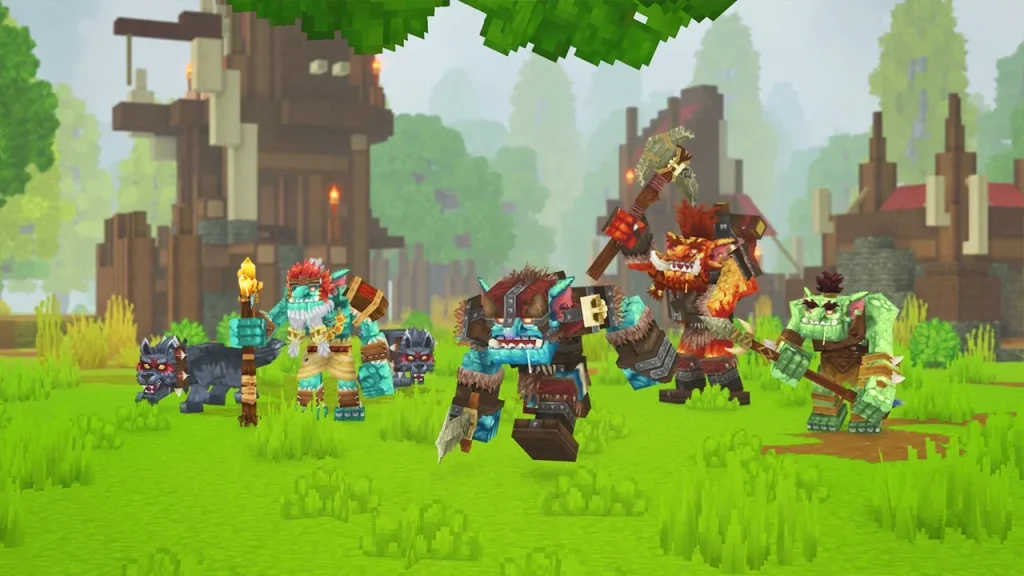
Hypixel Studios announced the Early Access date on November 28, 2025, and framed it as a deliberate choice: return to an older legacy build, ship something workable, and iterate in public. Pre-purchase began in December 2025, and Early Access went live on January 13, 2026. (Hytale)
At launch, Hypixel Studios stated that Early Access includes:
- Exploration Mode
- Creative Mode (including tools)
- Modding Support
- Multiplayer support across modes (Hytale)
They also openly list what is not in Early Access “yet,” which is a subtle but important shift from the pre-2025 era of Hytale communication: fewer promises, clearer boundaries, and an implied contract that the game will earn credibility through shipped updates rather than hype cycles. (Hytale)
That’s the real release story: Hytale is no longer a concept or a trailer—it’s a living product with patch notes.
Hytale vs Minecraft: Similar Blocks, Different Priorities

Comparisons to Minecraft are unavoidable, and in many ways fair. Hytale is built on the same intuitive truth that Minecraft popularized: blocks are a universal interface. Anyone can understand “place block, remove block,” and that simplicity creates enormous creative freedom.
But once you move past the surface, the two games reveal different priorities.
1) Building and Creative Expression
Minecraft’s strength is that its building is open-ended and mechanically simple. You can start placing blocks within minutes, and the community has spent more than a decade proving that limitations are often a creative advantage.
Hytale’s building, at least in intent, is designed to sit alongside a stronger set of integrated creation tools. Early Access includes Creative Mode and official tooling support—positioning creation as a first-class experience rather than something that emerges primarily through community-made tools and external mod loaders. (Hytale)
The practical impact of this difference will show up over time, not in day-one screenshots. If Hypixel can keep tooling stable, creators can spend less time fighting compatibility and more time producing content. Minecraft’s ecosystem is enormous, but it historically grew through fragmentation: different mod loaders, version mismatches, and a lot of community glue holding everything together. Hytale is trying to reduce that friction at the platform level.
2) Adventure Structure and “Game-iness”
Minecraft has goals (progression, Nether, End, bosses), but its default identity is “sandbox first.” A huge portion of play is self-directed: you decide whether you are a builder, miner, redstone engineer, or multiplayer grinder.
Hytale, from its earliest positioning, has leaned harder into the idea of a sandbox RPG—a world that feels more authored, with exploration and adventure content meant to stand on its own even if you never install a mod. Early Access explicitly includes an “Exploration Mode,” reinforcing that the studio wants a strong “playable adventure” baseline, not just a creative canvas. (Hytale)
If that design direction holds, the real comparison is less “Minecraft but prettier” and more “Minecraft’s building + a more structured RPG spine.”
3) Modding: Possible vs Supported
Minecraft modding is legendary, but it’s also famously uneven. The ecosystem is powerful because the community is brilliant—not because the experience is always streamlined.
Hytale’s value proposition is different: modding is positioned as a core pillar from the start, and Early Access explicitly ships with modding support. (Hytale)
And the early signals are strong. Within days of launch, coverage highlighted modders doing absurd technical stunts—running Windows 95, Minecraft, and more inside Hytale—less because anyone “needs” that functionality, and more because it demonstrates the flexibility of the platform and the enthusiasm of creators. (GamesRadar+)
This is exactly the kind of momentum that turns a game into a platform.
4) Multiplayer Identity: Server Culture vs Studio Infrastructure
Minecraft’s multiplayer culture is a universe: survival servers, economies, roleplay, minigames, custom clients, and communities that have existed for years.
Hytale’s origins are intertwined with one of the biggest Minecraft server ecosystems ever—Hypixel—so it’s not surprising that multiplayer is positioned as essential. Early Access includes multiplayer support across modes. (Hytale)
The key difference will be how much of the multiplayer experience is “standardized” by official tooling versus left to community invention. Minecraft’s server culture is chaotic in the best way; Hytale may end up more cohesive if the underlying systems are built to be extended cleanly.
The Rocky Development: Why Hytale Took So Long

Hytale’s development history is not “one delay.” It’s a series of compounding challenges that escalated expectations and then made those expectations difficult to meet.
The Trailer Effect: Announce Like You’re Shipping
Hytale’s original reveal created enormous hype. The project was visually appealing, ambitious, and positioned as something that could modernize the Minecraft-style sandbox genre.
The downside of a viral reveal is that the community locks onto an imagined timeline. Every year without a release doesn’t just feel like time passing—it feels like something going wrong. That’s the psychological trap of early hype: the longer it takes, the more the audience assumes the project is either stuck, mismanaged, or being endlessly rebuilt.
Riot Acquires Hypixel Studios: More Fuel, Higher Stakes
In April 2020, Riot Games acquired Hypixel Studios. Public messaging emphasized long-term support and resources, and framed Riot as a partner with experience operating successful games for years. (The Verge)
From a distance, it’s easy to assume an acquisition makes everything simpler. In practice, it often makes the project more ambitious—and more complex.
Bigger budgets and better infrastructure can remove constraints that previously forced hard decisions. That can be good (higher quality) or dangerous (scope creep). Hytale’s history suggests it was both.
Engine Overhaul and Vision Shifts
One of the most widely reported turning points is that Hytale underwent a major engine overhaul during the Riot era. Coverage around the studio’s later shutdown referenced setbacks and rework, including an engine overhaul in 2021. (The Verge)
This is where “rocky development” becomes structural. Engine changes are not just a technical choice; they ripple into everything: content pipelines, tools, modding APIs, multiplayer infrastructure, performance targets, and cross-platform aspirations. Rewrites also tend to invalidate work already done, creating a morale and momentum tax.
The Cancellation: June 23, 2025
On June 23, 2025, Riot announced that Hypixel Studios would be shut down and Hytale’s development would end. This was widely covered as the end of the road for the game, with commentary emphasizing years of effort that still couldn’t reach the studio’s intended promise. (The Verge)
At that point, the community’s assumption was reasonable: Hytale was effectively dead.
The Revival: “Hytale Is Saved” in November 2025
Then came the reversal. In November 2025, Hypixel’s original founders repurchased Hytale and announced the project had been saved. Hypixel’s official statement directly references the June 23, 2025 wind-down announcement and explains that the new plan was to revive the project by returning to a legacy build that had been abandoned. (Hytale)
This is the single biggest reason Hytale’s story is so unusual: it did not simply “survive delays.” It survived a public cancellation and then re-emerged under a different philosophy.
The Riot Games Era: What It Influenced (and Why It’s Complicated)
It’s tempting to compress the Riot era into a simple villain-or-savior narrative. That isn’t supported by how these situations typically work, and the public record points to a more nuanced picture.
What Riot Likely Contributed
- Resources and stability
Riot’s acquisition gave the studio more runway and the ability to hire and scale. That matters in a genre where polishing tooling, multiplayer, and modding support is expensive and complex. (The Verge) - Live-service operational expertise
Riot is known for long-running games with continuous patching and live operations. The acquisition messaging referenced Riot’s ability to help operate games long-term. (The Verge)
What the Riot Era Probably Changed for the Worse
- A higher “minimum bar” for release
Under a major publisher parent, “good enough” can become “not acceptable.” That can delay release even when the game is already playable. - Incentive for bigger scope (and rework)
When you have more resources, it becomes easier to justify engine rewrites and broader platform ambitions. Those decisions can be rational and still lead to multi-year delays. - A perfect-or-nothing failure mode
The 2025 shutdown was framed publicly as a hard conclusion reached after the game could not reach the promise and quality targets set for it. (The Verge)
In other words: Riot likely raised both the ceiling and the floor. The tragedy is that when the game couldn’t meet that floor on a workable timeline, the whole project was shut down—until the founders re-acquired it and chose a different strategy: ship earlier, patch faster, and build forward in public.
That philosophy shift is explicitly reflected in the Early Access messaging and the immediate publication of patch notes after launch. (Hytale)
Early Access Reality: The Game You Can Play vs the Game People Imagined
Because Hytale spent years in “myth” status, a lot of people built a perfect version of it in their heads. That imagined version had:
- A complete adventure campaign
- Deep progression systems
- Mature creator tooling
- Polished performance and stability
- A rich multiplayer ecosystem from day one
Early Access, by definition, does not deliver that fully. What it does deliver is a foundation that can now be judged on measurable realities:
- How quickly the developers patch issues
- Whether updates add real content, not just bug fixes
- Whether the modding ecosystem remains stable and accessible
- Whether performance, server reliability, and world generation improve
This is also where Hytale’s comparison to Minecraft becomes more fair over time. Minecraft didn’t start as the behemoth it is today—it became that through iteration, updates, and an ecosystem that grew year after year. Hytale is trying to start closer to “platform mode,” but it still has to earn maturity the hard way: by shipping.
Recent Updates Since Release: Hotfixes and Update 1
The most important difference between “Hytale as a promise” and “Hytale as a product” is that you can now track progress through official updates.
Launch-Day Hotfixes (January 13, 2026)
On launch day, Hypixel published a “Hotfixes: January 2026” post covering launcher authentication warnings and fixes, plus service-side improvements like patch distribution caching and email delivery capacity. (Hytale)
This sort of post is not glamorous, but it matters. It signals that the studio is doing live operations work immediately—exactly what a large Early Access launch forces you to do if you want to keep players from bouncing.
Update 1 Patch Notes (January 17, 2026)
Hypixel then shipped Update 1, publishing patch notes that explicitly describe it as the “first Hytale update,” with new content, fixes, and quality-of-life improvements, along with a commitment to rapid patching cadence. (Hytale)
Again, the specific content changes matter, but the bigger narrative point is cadence. Hytale’s biggest historical problem was not a lack of ideas—it was the inability to ship. The moment you start shipping regular updates, you reverse that reputation.
Community Activity as an “Update” Multiplier
Even while Hypixel patches the core game, the modding ecosystem is already acting as an acceleration layer. When modders are producing meaningful work quickly, it changes how the community experiences the game: the content surface area expands faster than the studio could expand it alone.
The early press focus on technically impressive mods (running other software inside Hytale, etc.) is partly novelty, but it’s also an indirect endorsement of the modding foundation. (GamesRadar+)
Planned Updates: What’s Next (and What’s Too Speculative)
When talking about “planned updates,” it’s important to stay disciplined. There are three kinds of claims people make about upcoming content:
- Official posts and patch notes (high confidence)
- Credible reporting summarizing official info (medium confidence)
- Community expectations and rumors (low confidence)
Right now, the best signals of “what’s next” come from official posts and the fact that some outlets are already referencing upcoming patch notes.
Update 2 Pre-Release Patch Notes (January 22, 2026)
GameRant reported that Hypixel revealed patch notes for a “next update,” describing it as “Update 2 Pre-Release Patch Notes” dated January 22, 2026, and listing categories such as cosmetics/customization, gameplay/balance, world generation, farming, and UI/UX. (GameRant)
This is a useful indicator of direction, even if you treat it as secondary reporting rather than the primary source. The categories themselves align with what you would expect in early live development: stabilizing core loops, improving the user experience, and expanding systems.
The Broader Official Direction
Hypixel’s Early Access announcement and launch framing repeatedly return to the idea that not everything is in Early Access “yet,” and that the game will grow through frequent updates. (Hytale)
The credible expectation, based on those statements and early update cadence, is:
- More content in Exploration Mode
- More tooling depth and polish in Creative Mode
- Continued improvements to world generation
- Multiplayer stability and scalability work
- Quality-of-life updates that remove friction for builders and modders
The exact shape of major future “milestone” features should be taken from official posts as they arrive, not guessed.
What Hytale’s Release Means for the Genre
Hytale’s Early Access launch is significant not because it instantly replaces anything, but because it reintroduces competition in a space that often feels like “Minecraft and then everything else.”
For years, many Minecraft-adjacent games tried to compete on one axis: better graphics, more survival realism, or a different theme. Hytale’s pitch is broader: a sandbox RPG foundation plus creator tooling plus multiplayer focus, all under one umbrella.
If Hypixel can maintain update cadence and keep modding stable, Hytale can become a second major gravitational center for builders and creators—not a “Minecraft killer,” but a parallel ecosystem.
That’s the more realistic outcome, and arguably the more valuable one. Minecraft’s longevity proves that the genre is not a zero-sum market. Players don’t abandon creative sandboxes permanently; they rotate between them based on what feels fresh, what their friends are playing, and where creators are building the most interesting new content.
The Trust Problem: Hytale’s Real Challenge After a Rocky History
Hytale’s biggest enemy is not Minecraft. It’s skepticism.
After years of delays, engine overhauls, and then a public cancellation, players have learned to be cautious. The studio appears to understand this, which is why the communication tone since November 2025 has been direct: this is Early Access, it is incomplete, and it will improve through rapid patches. (Hytale)
The studio is also benefiting from a compelling narrative reversal: a founder buying back the game and shipping it quickly. PC Gamer’s coverage emphasizes that this revival has already generated strong interest and funding runway from early access sales, along with major attention on Twitch at launch. (PC Gamer)
But the narrative only lasts if the updates keep coming.
The practical questions players will use to judge Hytale over the next six to twelve months are straightforward:
- Do updates arrive frequently and meaningfully?
- Do patch notes reflect real priorities (performance, stability, quality-of-life)?
- Does the modding ecosystem remain accessible and stable across updates?
- Do creators feel supported rather than broken by version churn?
- Does multiplayer improve in reliability and usability?
If the answer to those becomes “yes” consistently, Hytale’s rocky development will become backstory rather than baggage.
Final Thoughts: Hytale’s Release Is a Beginning, Not a Victory Lap
Hytale entering Early Access on January 13, 2026 is the most important milestone in the project’s history—not because it proves everything, but because it finally makes progress measurable. (Hytale)
The game’s long road—Riot acquisition in 2020, years of ambition and rework, shutdown and cancellation in June 2025, and the “saved” revival in November 2025—created enormous expectations and equally enormous skepticism. (The Verge)
Now it’s in the only state that can resolve both: a playable product under active development, shipping hotfixes and updates, with an early modding ecosystem already proving what’s possible. (Hytale)
Minecraft will remain the cultural titan for a long time. But Hytale does not need to dethrone Minecraft to matter. If it delivers a steady cadence of improvements and keeps its creator tooling strong, it can become the second major home for builders, modders, and multiplayer communities who want something that feels familiar, but not stuck in time.
And after everything, that is the real headline: Hytale is no longer “the game that might come out someday.” It’s here. Now it has to earn the future it promised.
Please Read Our Blog, Visit Our Store & Contact Us
If you want help applying this guide to a PC or upgrade, talk directly with the Glitchtech builders.
Talk to a builder
